


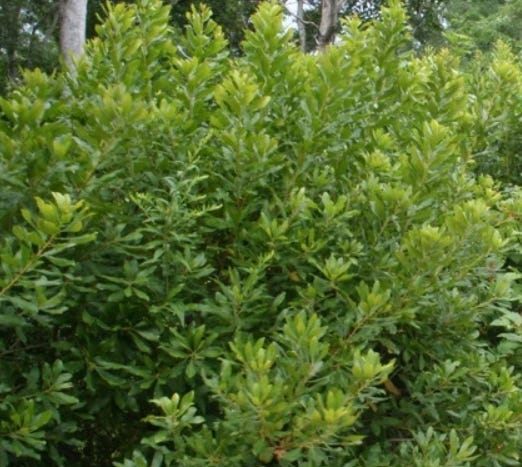
Some plants announce themselves with flowers.
Bayberry is quieter.
It grows along sandy roads, old fields, dunes and coastal edges. Its leaves are leathery and aromatic. Its berries are small, gray-white and almost dusty-looking.
Yet those modest berries once helped light American homes.
Northern bayberry, Morella pensylvanica, formerly known as Myrica pensylvanica, is one of the characteristic shrubs of the northeastern coast.
Its old common name tells much of the story:
Candleberry.
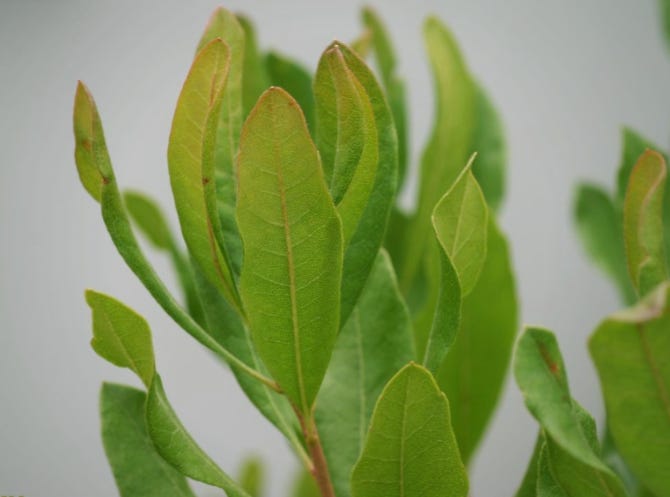
A Shrub Made for the Coast
Bayberry seems almost designed for New England.
· sandy soil
· salt exposure
· wind
· drought once established
· poor fertility
· open coastal conditions
Crush a leaf between your fingers and the plant reveals another quality: a resinous, spicy fragrance.
Bayberry plants are generally either male or female. The female plants produce the famous pale berries only when a male plant is close enough for pollination.
Those berries are covered with a thin natural wax. And that tiny coating gave bayberry an extraordinary place in household history.
Before the Candle
Long before European colonists began rendering bayberry wax, Indigenous peoples of northeastern North America already knew the plant.
Various Native communities used parts of bayberry and related species in household and medicinal preparations.
As always in Simples & Worts, those traditions deserve to be understood as historical and cultural knowledge rather than automatically converted into modern prescriptions.
The plant existed in human life long before a European settler ever called it candleberry.
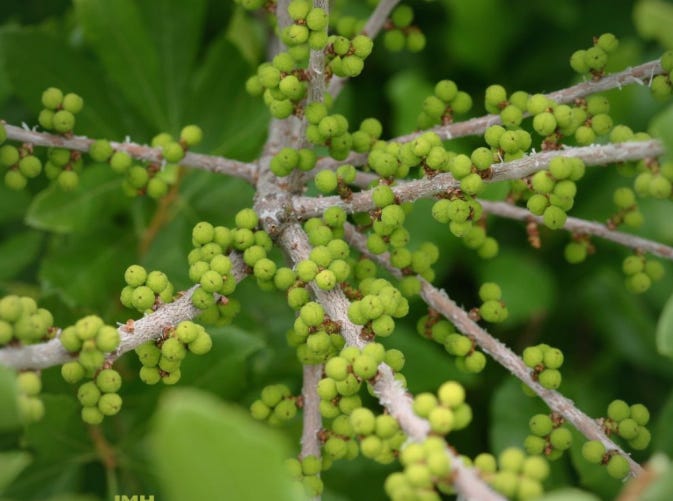
We usually see the berries in their gray state.
When Berries Became Light
European settlers quickly discovered that bayberry fruit could be simmered in water. The wax coating melted. The wax floated. When the water cooled, a thin greenish layer could be lifted from the surface.
The process sounds simple. It was not.
A vast number of berries produced surprisingly little wax. That made bayberry candles costly in terms of time and labor.
But compared with common tallow candles, bayberry wax had tremendous appeal. Tallow could smoke. It could smell unpleasant. Bayberry wax burned more cleanly and carried its own fresh, resinous scent.
So the humble coastal shrub became something luxurious.
Red Gold Had Saffron. Green Gold Had Bayberry.
The comparison is irresistible.
Saffron requires thousands of flowers to produce a tiny quantity of spice. Bayberry requires thousands of berries to create a modest amount of wax.
In both cases, scarcity comes not from rarity of the plant but from the astonishing amount of hand labor required to turn the harvest into something useful.
The berries had to be gathered. Sorted. Boiled. Skimmed. Rendered again. The wick had to be prepared. The candle dipped repeatedly.
A single good candle represented hours of work.
Why Save a Bayberry Candle?
Because it was special.
A family might burn ordinary tallow for everyday light. Bayberry could be reserved for guests, celebrations or important winter evenings.
Over time, one particular tradition became attached to it.
Burning a bayberry candle on Christmas Eve or New Year’s Eve was said to bring good fortune in the coming year.
The old sentiment survives in many variations: Luck to the household. Food to the larder. Gold to the pocket.
Like most folk sayings, it probably changed as it passed from family to family. But the symbolism is easy to understand.
A candle requiring so much labor already represented abundance. To burn one completely was almost an act of confidence.
Bayberry and the New England Winter
There may also be a reason the plant became so closely associated with the cold season.
Its berries remain visible after much of the garden has disappeared. Their colors are not bright. They are coastal colors: sage, silver, gray, sand, winter green.
Birds feed on the persistent fruit. The foliage holds fragrance. And when winter evenings arrive early, those pale berries remind us that the landscape is not entirely asleep.

Is Bayberry an Herb?
Botanically, no. It is a woody shrub.
But historically, plants were not always divided into today’s neat categories. Leaves, roots, berries, bark, resin and wax could all belong to the household world of useful plants.
In that older sense, bayberry fits comfortably beside the simples and worts. It was useful. It was aromatic. It was gathered. It was transformed.
Bayberry at Roadstead Farms
For a Cape Cod landscape, bayberry almost feels inevitable.
It already belongs to the place. Its muted silver-green coloring fits beautifully with lavender, white flowers, silver foliage and dark earth mulch.
And unlike a brilliant red-berried shrub, bayberry does not fight a restrained garden palette. It whispers rather than shouts.
That may be its greatest ornamental virtue.
The Plant Behind the Tradition
The bayberry candle story is charming. But the plant itself deserves equal attention.
This is a native shrub that holds dunes, feeds wildlife, tolerates difficult soils, survives salt and wind, and contributes subtle winter structure.
The candles were only one expression of its usefulness. The shrub was already doing important work before humans ever placed a kettle over the fire.
A New England Plant With a Long Memory
Bayberry belongs to a particular kind of landscape.
A windswept road. A sandy pasture. A coastal thicket. A winter field.
Its fruit is small. Its flowers are nearly unnoticed.
Yet for generations it supplied fragrance, medicine, wildlife food, household craft and, for a few precious winter evenings: light.
That may be reason enough to plant one.
SIMPLES & WORTS FIELD NOTE
Botanical name: Morella pensylvanica
Older name: Myrica pensylvanica
Common names: Northern bayberry, candleberry
Family: Myricaceae
Plant type: Native woody shrub
Fruit: Waxy gray-white berries on pollinated female plants
Fragrance: Resinous, aromatic foliage
Historic household use: Candle wax and other domestic uses
Season of greatest interest: Autumn through winter
Garden character: Coastal, durable, aromatic and distinctly New England