
Before sempervivums became popular as cheerful container plants, they lived in the older imagination as plants of the roof, the hearth, and the household. Their Latin name, Sempervivum, means something close to “always living,” which suits them perfectly. They cling to life in lean places, hold moisture in their leaves, and survive where many softer plants would give up. The common houseleek, Sempervivum tectorum, carries that history in its name: tectorum points to roofs, and the plant was long associated with old roof tiles, stone buildings, and thatched cottages.
In European folklore, houseleeks were often planted on roofs because people believed they helped protect the home from lightning, fire, storms, and misfortune. The Metropolitan Museum of Art’s medieval garden notes describe Sempervivum tectorum as “the ever-living one of the roofs” and connect it with magical protection against lightning. The Met also notes that, to the medieval mind, houseleek had the power to ward off lightning from rooftops.
That old belief makes sense when we picture earlier houses with thatched or sod roofs, where a plant that held water in its leaves and grew close to the roof surface may have seemed like a living guardian. The old herbal tradition also repeats the story that Charlemagne ordered houseleeks to be planted on roofs, likely because of this protective association.
Whether we take the folklore literally or not, the feeling remains wonderfully useful for the herbal maker. Sempervivums still feel like household plants in the oldest sense of the word. They are little living charms. They sit well on stone, wood, slate, troughs, bowls, and weathered objects. They bring the garden close to the table, the doorway, the terrace, and the windowsill. They make a project feel rooted in something older than decoration.
Most gardeners know them as hens and chicks. The “hen” is the larger central rosette, and the “chicks” are the small offsets that gather around her. That habit alone makes them perfect for quick outdoor projects. One plant becomes a family. One cluster becomes a little village. One trough or bowl can look composed almost as soon as the plants are tucked into place.
Why Sempervivums Are So Good for Maker Projects
Sempervivums are ideal for simple garden projects because they already have strong natural form. Each rosette looks like a small green flower made of leaves. Some are bright green, some are silvered, some are tipped with burgundy, and some take on rosy or plum tones depending on the season and variety. You do not have to fuss over them to make them look interesting. Their geometry does half the work for you.
They are also forgiving. Because they store moisture in their leaves, they can tolerate temporary displays better than many plants. They do not need rich soil, and they dislike wet, heavy conditions. This makes them especially useful for troughs, stone pockets, shallow bowls, old garden ornaments, and outdoor table pieces. They are not asking for luxury. They are asking for sun, drainage, and a little restraint.
That restraint is part of their charm. In the herbal life-style, not every project needs to be large, expensive, or complicated. A good maker project should invite the hand and reward the eye. Sempervivums do exactly that. They let us create something beautiful in a short amount of time, often using pieces we already have around the garden.
Project One: An Outdoor Table Centerpiece Without Soil
One of the easiest projects is an outdoor table centerpiece made with sempervivum rosettes, moss, stones, and a shallow vessel. This is a temporary display, not a permanent planting, but it is a lovely way to dress a garden table for lunch, tea, supper outdoors, or a small gathering. It gives the table a living centerpiece without the mess and weight of a soil-filled planter.
Begin with a shallow bowl, tray, wooden dough bowl, old platter, low basket, or weathered garden dish. If the container is open or uneven, line it lightly with moss. The moss gives the rosettes something soft to rest in and helps the arrangement look finished. You can use sheet moss, sphagnum moss, or dried decorative moss, depending on what you have.
Choose a few larger hens and a handful of smaller chicks. Place the largest rosette first, slightly off center, so the arrangement does not look too stiff. Then tuck the smaller rosettes around it, letting them gather the way they do naturally in the garden. Add a few small stones, shells, seed heads, or bits of driftwood if they suit the setting, but do not overdecorate. Sempervivums already have strong form, and the best arrangements usually let the plants remain the stars.
Mist the arrangement lightly and place it outdoors on the table. It should feel low, calm, and sculptural. It should not block conversation across the table. After the event, return the rosettes to a gritty planted container, trough, or garden bed. That is the beauty of this project: the centerpiece has its moment, and then the plants go back to living.
Project Two: A Stone Pocket or Crevice Planting
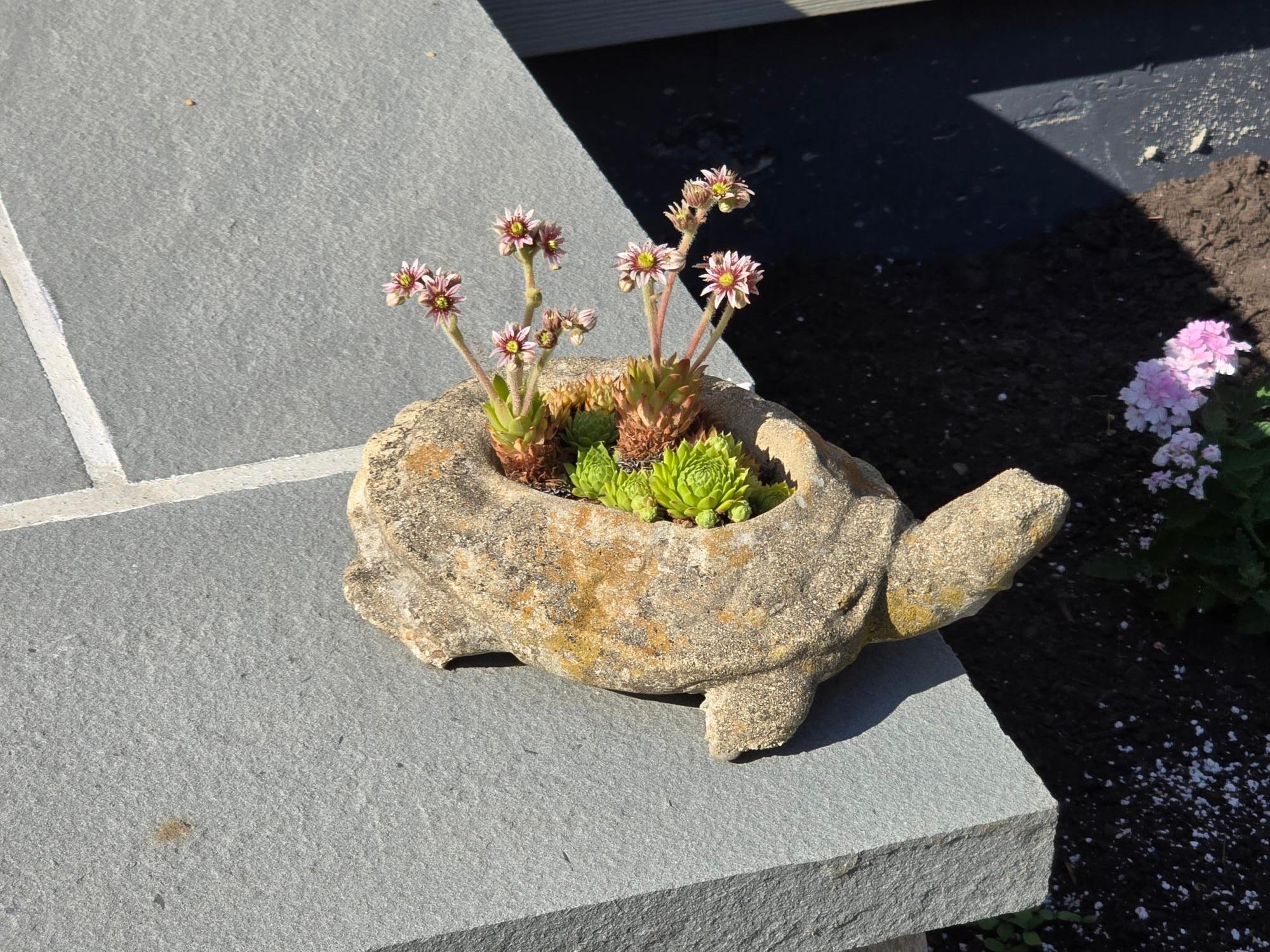
The second project is the kind shown in the attached photo: a weathered stone-like object with a small planting pocket filled with hens and chicks. This may be one of the most charming ways to use sempervivums because the plant and container seem made for one another. The stone looks old, the rosettes look ancient, and the whole piece feels as though it has been sitting happily in the garden for years.
A stone pocket planting can be made in many kinds of objects. You might use a stone trough, a broken urn, a carved garden ornament, a hypertufa bowl, a shallow concrete piece, a hollowed stone, or even a weathered turtle, bird, or shell-shaped container. The exact object matters less than the feeling. It should have a pocket, crack, hollow, or shallow planting space where the sempervivums can sit naturally.
Use a gritty, fast-draining mix. This is important. Sempervivums do not want to sit in wet, rich soil. A lean mix with grit, small gravel, or sharp drainage suits them far better than a heavy potting soil. If the object does not drain well, be careful. Either drill drainage if possible or use the piece as a temporary display and protect it from heavy rain.
Plant the largest rosette first, then tuck the smaller chicks around it. Let some of them lean toward the edge or spill slightly from the pocket. This style should not look too symmetrical. It should look discovered. A good stone pocket planting feels as though the plant found the crevice on its own and decided to stay.
If one of the rosettes sends up a flower stalk, enjoy the show. Sempervivum flowers can be surprisingly whimsical, rising above the tight rosettes on sturdy stems. The blooming rosette will eventually decline after flowering, but the surrounding chicks carry the colony forward. That is another reason these plants feel so full of lore: the mother rosette gives her great flowering gesture, and the next generation remains.
Where to Place These Projects
Sempervivum projects are happiest outdoors in sun and good air. They are excellent on patio tables, stone steps, terrace walls, garden benches, old brick, slate, gravel, and weathered wood. They look especially good where the container can pick up a little age. A brand-new pot may work, but a worn trough, old stone piece, or mossy garden ornament usually has more soul.
They also pair beautifully with the materials of an herbal garden. Slate, terra cotta, granite, shell, driftwood, gravel, and old brick all make good companions. The goal is to make the project feel as though it belongs to the garden, not as though it was dropped into the garden from a craft store.
For the table centerpiece, think temporary beauty. For the stone pocket, think longer-term garden charm. In both cases, the project should be easy to assemble and easy to enjoy.
A Few Simple Care Notes
Give sempervivums sun, lean soil, and excellent drainage. Avoid rich, soggy conditions. Do not overwater them, especially in shallow containers or stone pockets. If you are using them in a soil-free centerpiece, mist lightly and return them to a planted home after the display has served its purpose.
The plants can be divided when the chicks are large enough to handle. Gently separate the offsets and tuck them into gritty soil. In time, one small cluster can become many little projects. That is why sempervivums are such satisfying plants for makers. They multiply quietly, and they invite you to keep playing.
The Herbal Maker’s Joy
Sempervivums remind us that the herbal life-style is not only about the kitchen or the medicine chest. It is also about the old household arts of making, placing, arranging, and charming the spaces where we live. A handful of hens and chicks can turn a shallow bowl into a table piece. A weathered object can become a tiny planted world. A stone pocket can become a living charm by the door.
That is why I love them for quick projects. They are thrifty, durable, beautiful, and full of story. They carry old roof lore into the modern garden. They ask very little, but they give back a great deal.
Simple.
Sturdy.
Ever-living.
And always ready to make an ordinary object feel enchanted.
Until next time...
I am...
Phil Wilson...
and Here’s to sharing our herbal life-style with you!

vidIQ


