
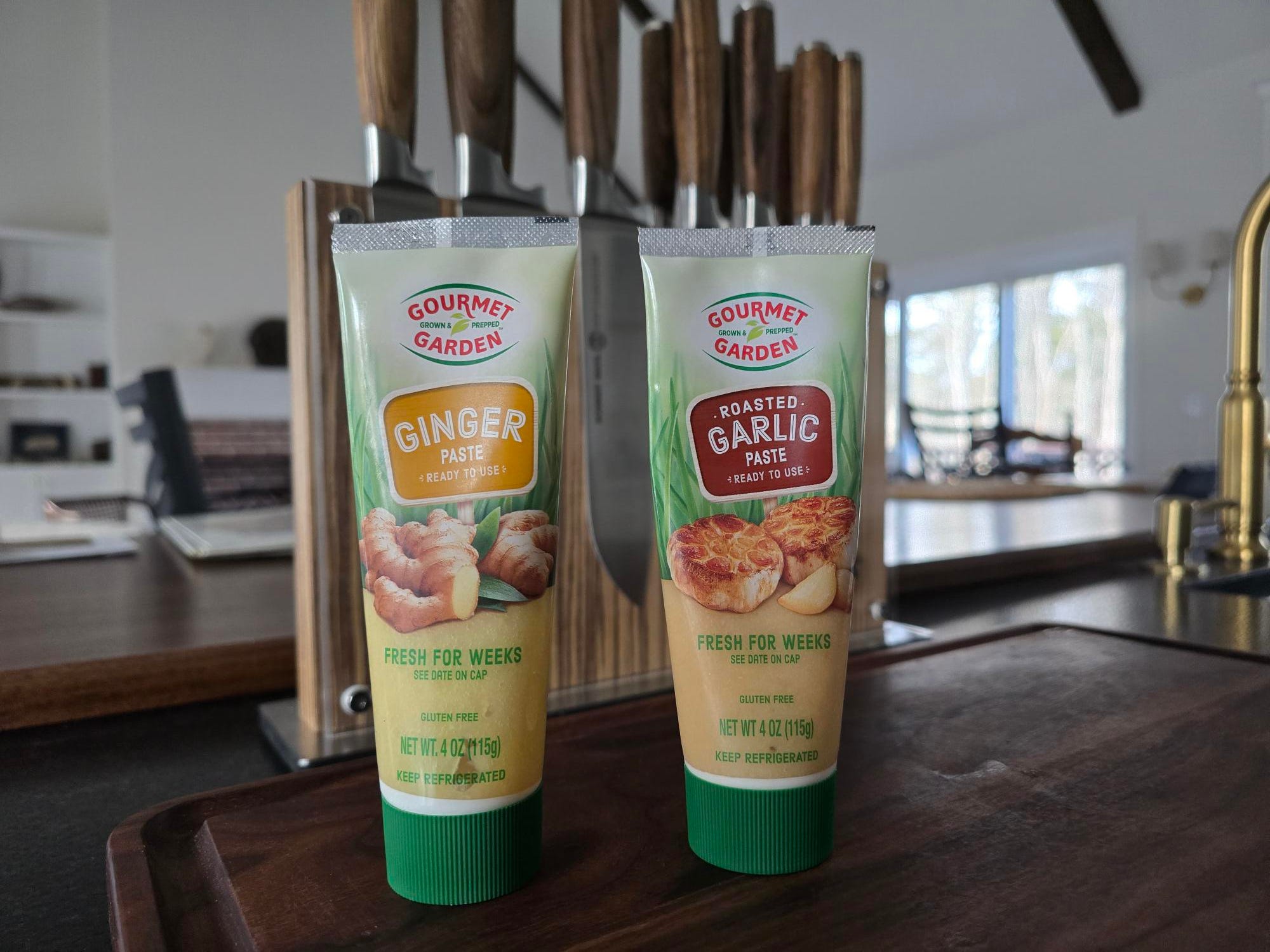
If you’ve walked the produce aisle lately, you’ve seen them: squeezable tubes and stir-in pastes for roasted garlic, ginger, basil, cilantro, lemongrass, and more. They promise speed, consistency, and fewer sticky cutting boards. And for busy weeknights (or “I forgot to thaw anything” nights), they can feel like culinary magic.
But your question is the right one: what are we trading for that convenience—flavor, nutrition, or a pile of additives?
Let’s make this practical and grounded: what these products are, what’s typically inside, how to pick the “great” ones, and when fresh still wins.
What these products really are
Most “squeezable herbs” and “stir-in pastes” fall into three families:
Refrigerated herb/garlic/ginger pastes (tubes/jars)
These are often acidified and stabilized so they stay safe and spreadable. Example ingredient lists show acids, sweeteners, and gums alongside the herb itself.Frozen cubes (garlic/herbs)
Typically a shorter ingredient list—often just the plant plus water/oil/salt.Jarred minced ginger/garlic (refrigerated)
Often preserved with vinegar/citric acid, sometimes with added sugar.
None of these are “fake.” They’re just processed for stability—and that’s where additives come in.
The big safety note (especially for garlic)
Garlic and herbs are low-acid foods, and when they’re mixed with oil and stored improperly, there’s a known risk of botulism in homemade or poorly formulated garlic/herb oil mixtures. That’s why reputable guidance emphasizes acidification (lowering pH) and/or proper refrigeration/time limits.
This is also why many commercial garlic/herb pastes include acids like citric acid, acetic acid, or vinegar, and why labels often say keep refrigerated.
Bottom line: commercial products from reputable brands are generally formulated to be safe when you follow the label. The risk tends to show up when people make infused oils at home without the research-based acidification steps.
“What are these additives, and should I worry?”
Here’s a cheat sheet using real ingredient lists as examples.
Roasted garlic paste example (refrigerated)
One common roasted garlic paste lists: roasted garlic, water, glycerin, canola oil, sea salt, corn maltodextrin, dextrose, citric acid, acetic acid, xanthan gum.
What those “extras” do:
Citric acid / acetic acid: lowers pH, brightens flavor, supports safety/stability.
Xanthan gum: keeps it squeezable and prevents separation.
Glycerin: helps texture and moisture retention.
Maltodextrin + dextrose: mild sweetness, texture, and stability; also helps carry flavor.
Ginger paste example (refrigerated)
A ginger stir-in paste example lists: ginger, dextrose, glycerin, fructose, sea salt, ascorbic acid, xanthan gum, citric acid.
Notable items:
Ascorbic acid (vitamin C): antioxidant—helps protect flavor and color.
Fructose/dextrose: sweeteners and stabilizers; not “bad,” but worth noticing if you’re avoiding added sugars.
Jarred minced ginger example
A jarred organic minced ginger example lists: ginger, cane sugar, rice vinegar, citric acid.
That’s a short list, but it does include added sugar.
Frozen garlic cube example
A frozen crushed garlic cube example lists: garlic, water, oil, sea salt.
Short and clean—though still “processed” (just minimally).
So… are they OK or great?
Here’s a simple, practical scoring approach.
“Great” (I’d buy again)
Choose products that:
Have the plant as ingredient #1 (garlic/ginger/herb)
Use acids/antioxidants/gums sparingly for stability (citric acid, ascorbic acid, xanthan gum)
Have little to no added sugar (or it’s not a flavor you’ll mind being slightly sweet)
Fit how you cook (roasted garlic paste is naturally sweeter/rounder; ginger paste may be slightly sweet depending on brand)
Best use: weeknight cooking, marinades, soups, sauces—anywhere you want fast flavor without prep.
“OK” (useful, but not your daily driver)
Products that:
Include multiple sweeteners (dextrose + fructose) or starches (maltodextrin)
Have higher sodium than you prefer (especially if you’re salting food elsewhere)
Taste a bit “flat” compared with fresh (common with basil/cilantro pastes)
Best use: “backup flavor” when you’re out of fresh herbs.
“Skip” (for your pantry)
Products that:
Taste noticeably processed to you (this is personal)
Hide a lot behind vague terms (e.g., “natural flavors”)
Have a long list where the herb is no longer the star
Flavor reality: what you gain and what you lose
What you gain
Consistency: same intensity each squeeze
Speed: no peeling, grating, or mincing
Less waste: especially for ginger and tender herbs
What you lose (sometimes)
Fresh top notes: basil/cilantro can lose “bright, leafy” punch compared with fresh
Textural impact: fresh garlic and ginger have a sharper bite; pastes can be smoother/rounder
A good rule:
Use fresh when the herb is the headline (pesto, chimichurri, fresh salsa verde).
Use paste/tube when the herb is the supporting actor (soups, marinades, stir-fries, braises).
Storage and handling: how to keep them “great”
Follow the label—many are refrigerated products for a reason.
Use clean utensils/no double-dipping if you’re scooping from a jar.
If you’re making your own garlic/herb oils at home, use research-based acidification methods or keep refrigerated and use quickly—home infused oils are a different safety category than commercial pastes.
My practical recommendation for Simples & Worts readers
For most home kitchens, these products are absolutely OK—and for many people they’re great, especially for garlic and ginger.
If additives concern you, pick one of these strategies:
Go “short list” (fewer ingredients)
Frozen cubes are often a win here.Accept a little stabilization for big convenience
Citric acid, ascorbic acid, and xanthan gum are doing functional work in these pastes.DIY and freeze (the gold standard)
Make your own garlic/ginger paste, portion into ice cube trays, freeze, then store cubes in a bag. You get convenience with total ingredient control.
A tiny “label-reading” checklist
When you pick up a tube/jar, ask:
Is garlic/ginger/herb listed first?
Any added sugars (dextrose/fructose/cane sugar)? How do you feel about that for this use?
Any acids (citric/acetic/vinegar)? That’s usually helping stability/safety.
Any gums (xanthan)? That’s texture.
Does it taste good to you? (The most honest metric.)
The bottom line
If you love roasted garlic and ginger pastes, you’re not taking a risk, nor “cheating”—you’re choosing a tool. With a quick label scan and proper storage, these can be a smart, flavorful convenience for an herbal lifestyle that’s actually lived (not just imagined).
Until next time...
I am...
Phil Wilson...
And, here’s to living an Herbal Lifestyle With You!


