
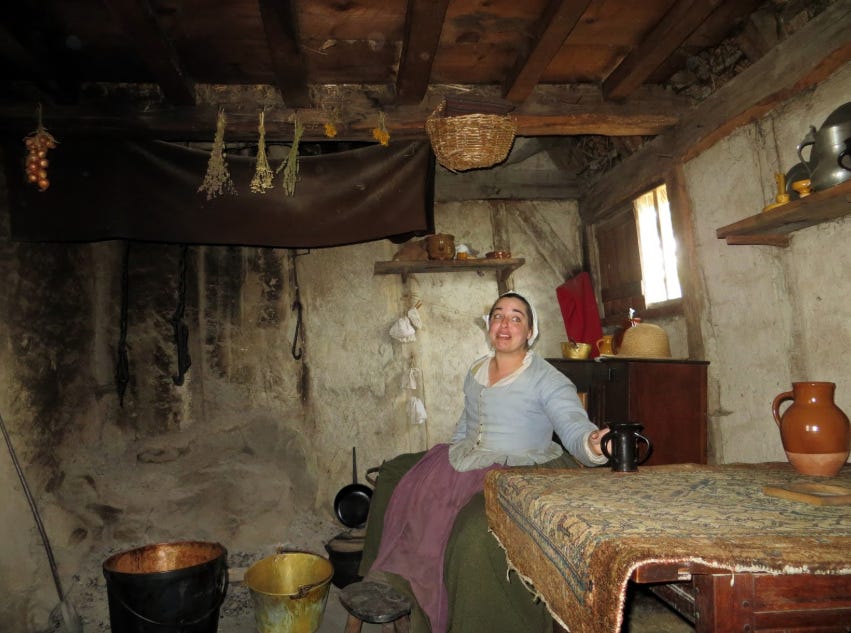
In the year of our Lord 1673, when the wind had a bite like a file and the dunes kept their own counsel, there stood a small house near the marsh edge—low roof, tight shutters, and a chimney that drew like a stubborn mule.
Within it lived Mistress Elspeth Thorne, widow to a cooper and keeper of a modest physic garden. Some called it a “witch’s patch” when they thought themselves unheard. Yet when children ran hot with fever or men came home from sea with hands split and salted raw, those same tongues learned to say, “Fetch Elspeth.”
On that night, the salt lantern was lit—an old ship’s lantern hung on a nail by the door. Not for show, but for mercy. It signaled: This house will receive trouble.
Elspeth was grinding dried sage and rosemary in a small stone mortar when she heard the first knock—too hard, too urgent to be neighborly.
“Goodwife Thorne!” came a voice through the crack. “For charity’s sake!”
She opened the door to find two men bearing a third between them like a broken spar. The injured fellow’s coat was stiff with seawater and darker things besides. His left arm was bound in a cloth that had lost the battle.
“He took a gaff,” one man said, breath smoking. “Slipped on the deck. The iron took him.”
Elspeth did not waste speech. She saw the pallor, the tremble, the way the man’s jaw worked as if chewing pain.
“Lay him by the hearth,” she said. “And you—fetch clean water. Boil it, if God grants you time enough.”
They set him down. Elspeth pulled away the sodden cloth with care, for cloth can become cruelty when it clings. The cut was deep at the forearm, ragged at the edges, and angry already.
“Hold still, friend,” she murmured, not as command but as invitation. “I shall do what I may.”
The injured man’s eyes found hers. “I’m no friend,” he rasped. “I’m only… cold.”
She touched his forehead. Not fevered—yet. But the cold that follows shock is its own warning bell.
Elspeth took a small bundle of dried yarrow from a peg and crumbled it between her fingers. Yarrow had a reputation among sailors and soldiers—some swore it could coax blood to cease its running. She did not promise miracles, only aid.
Into a clean cloth she placed yarrow and a pinch of ground plantain leaf—a “common weed,” many said, until it was the very thing you needed. She poured a thread of hot water over the herbs, just enough to wake them, and pressed the warm mash to the wound.
The man hissed and tried to pull away, but Elspeth caught his wrist gently.
“Nay,” she said. “Let it be. The sea has already taken its share.”
While the poultice sat, she set a pot to warm. Into it she put water, then a small spoon of honey and a dash of vinegar—an old habit meant for cleansing. She would not pour spirits into him; she had seen too many men warmed falsely by drink and left worse in the morning.
“You there,” she said to the standing men, “hold him steady. And do not be heroic—be useful.”
One of them made the sign of the cross. The other looked about the room, eyes snagging on her drying bundles of herbs like a man looking for something to blame.
At that moment the door opened again—softly, without the blunt ignorance of a stranger.
A young woman entered, cloak drawn close, hair dark as wet earth. She carried a small parcel wrapped in bark and twine. Her steps were quiet, but not timid.
Elspeth knew her: Wáhtah, who sometimes came to trade dried berries, shells, or knowledge—true knowledge, earned by long watching, not by boasting.
Elspeth nodded once in greeting, not wanting to make a spectacle.
Wáhtah’s gaze took in the injured arm and the man’s shaking breath. She knelt, reached into her parcel, and withdrew a strip of inner bark—pale and fibrous—and a lump of resin dark as amber.
She spoke in careful English. “He bleeds inside his skin. It will swell. Pain will make him stupid.”
“I have yarrow and plantain,” Elspeth answered.
Wáhtah nodded. “Good. And this”—she held up the bark—“is from willow. For the ache.”
Elspeth’s eyes narrowed in thought. She had heard of willow for pain from other mouths too—an old remedy traveling many roads. Yet she knew also that any physic taken within must be measured with humility. Remedies can help, and remedies can harm; the body is not a bucket you may fill with whatever you please.
“And the resin?” Elspeth asked.
“To seal,” Wáhtah said. “Not on the open wound—after. When clean.”
Elspeth did not debate. Tonight was no time for pride.
Together, they worked as if they had long practiced it: Elspeth cleansing and dressing, Wáhtah preparing what she brought with hands quick and certain. The men watched in the uneasy silence of those who do not like to admit what they do not know.
When the bleeding slowed, Elspeth bound the arm with fresh cloth—not too tight, for swelling is a sneaking enemy. Then she warmed a little broth and fed the injured man spoon by spoon until his breathing eased.
Only then did she speak to the others.
“He must rest. If fever comes, you return at once—do you understand? If red streaks travel up the arm, you return. If his mind wanders and he talks to shadows, you return.”
“Aye,” the men said, as though “aye” were a charm itself.
Wáhtah rose and moved to the small window, peering out at the black line of dunes. “Storm comes,” she said.
Elspeth followed her gaze. The night was too still, the air too heavy. Storms on the Cape do not always announce themselves kindly.
“Then we shall keep the lantern lit,” Elspeth said.
The injured man stirred, eyes fluttering. “Is it… witch-work?” he whispered, voice small as a boy’s.
Elspeth let out a single breath, not quite laughter. “’Tis work,” she said. “And work is never witchcraft. Now hush.”
Wáhtah came back to the hearth and placed one small bundle in Elspeth’s hand—mint, perhaps, and something sharper.
“For the belly,” she said. “When fear sits there.”
Elspeth nodded. “I shall use it wisely.”
The storm arrived before midnight, hurling sand against shutters as if the earth itself were angry. Elspeth kept watch by the hearth, listening to the injured man’s breathing and the occasional pop of the fire.
Near dawn, his shaking ceased. His face held color again. He slept, not the ragged sleep of pain, but a steadier kind.
Elspeth sat back at last, shoulders loosening. Wáhtah had gone in the dark without ceremony, as she often did—leaving only footprints and the faint scent of pine resin.
When the gray light finally filtered in, one of the sailors returned, hat in hand.
“He’s alive?” he asked, as if the question might break the spell.
“He is,” Elspeth answered. “And if he keeps his sense and you keep your care, he may remain so.”
The man swallowed and looked down, shame and gratitude wrestling in his throat.
“I spoke ill of your garden once,” he said quietly.
Elspeth raised an eyebrow. “Did you now.”
“Aye. Said it was… unnatural.”
Elspeth leaned on the doorframe and looked past him to the pale sweep of the marsh. “There is nothing unnatural in green things,” she said. “Only in the stories folk tell when they are afraid.”
He nodded, unable to meet her gaze.
“And tell your fellows,” she added, “that if they must gossip, let them gossip this: that herbs do not replace sense. They only lend it a hand.”
The man left then, stepping into the wind with more humility than he brought.
Elspeth closed the door, glanced at the lantern, and set a fresh wick. The sea would not cease sending trouble. The Cape would not cease being the Cape.
But she had her small garden, her mortar and cloth, her discipline, and the quiet alliance of those who knew that knowledge is not owned—only carried.
And for a moment, before the day’s work began, she allowed herself one simple thought:
Even in the harshest season, something green may yet be found—if you know where to look.


